
Boxing 101

A Guide to Corrugated Box Types and Uses.
There’s more to a corrugated box than meets the eye—its strength lies in the fluting.
This guide breaks down structure, strength, and performance so you can choose with confidence.
At Whitebird, we make smarter packaging decisions simple.
Understanding Fluting in Corrugated Boxes
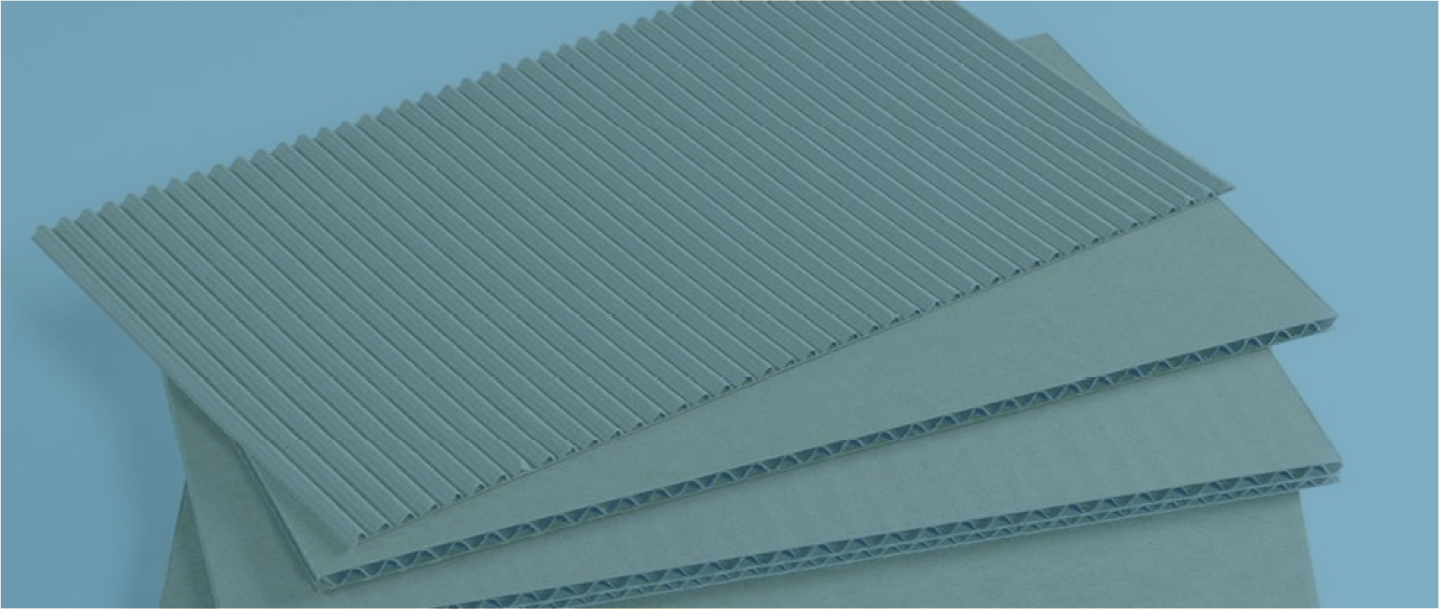
The strength of corrugated cardboard comes from the wavy layers—aka “fluting”—that lie between the flat layers (linerboard) of cardboard. This doesn’t just add rigidity and strength but also provides cushioning for whatever is inside.
In addition to fluting, the other factor which strengthens the box is the thickness of the liner. By using a higher grade liner the box will be more ridged and offer more support for weightier items. It will also improve the print quality as you increase the liner grade. You can also double or triple the board to further enhance the protection and capacity.
To put it simply, single-wall boxes are ideal for light to medium weight items. The standard for most lightweight packages is 32C which can handle a max weight of 65 lbs for palletized shipments and 32lbs for parcel. You can upgrade your liner to handle more weight, or move to a double-wall or triple wall box which can handle substancially more weight and offers more protection.

Understanding box certificate stamps.
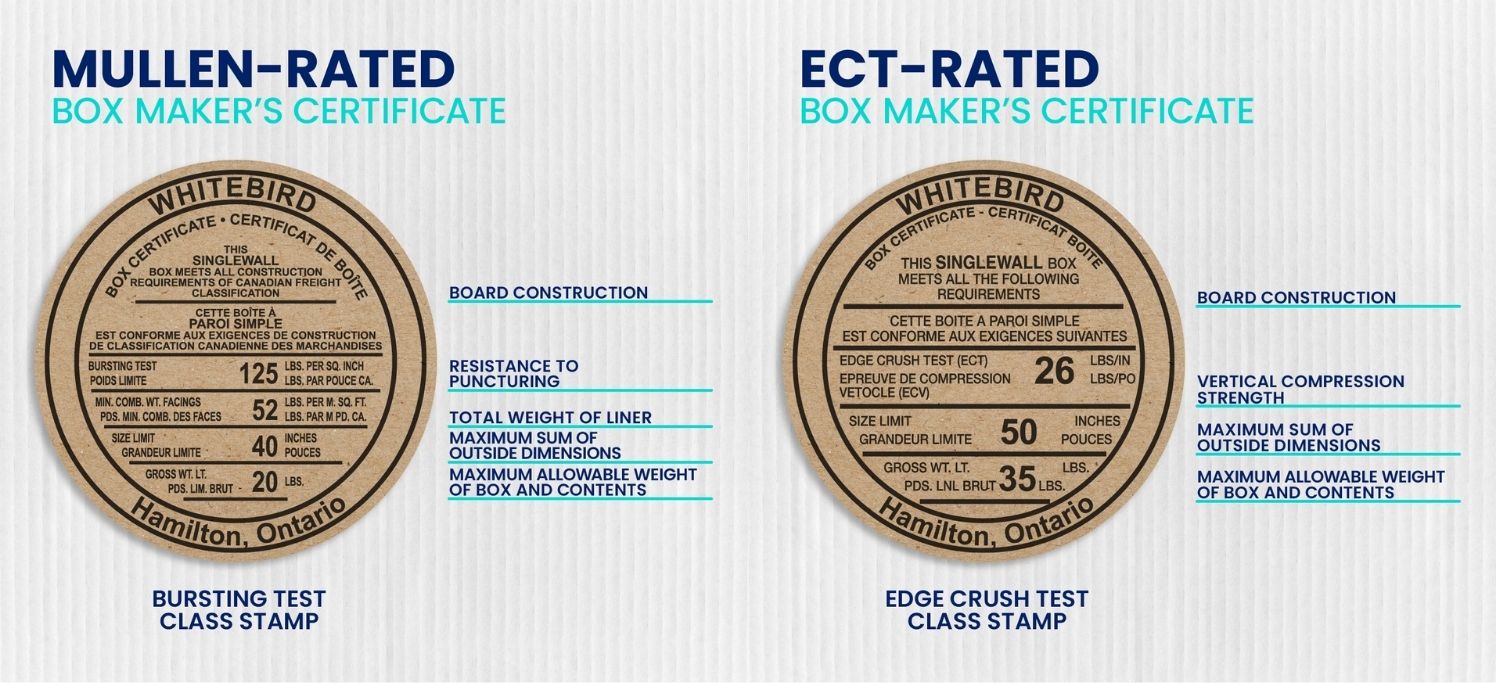
Most corrugated boxes include a printed stamp—typically found on the bottom—that indicates the box’s strength and construction. This stamp provides important details such as:
- The box structure (e.g., single wall, double wall)
- The strength rating, shown as either ECT (Edge Crush Test) or Burst Test
- The maximum weight and dimensions the box is rated to carry
These details help ensure your packaging meets your freight carrier’s shipping requirements. Following these guidelines helps prevent damage during transit and reduces the risk of rejected shipments or denied claims.
Not sure what your carrier requires? Most freight carriers publish reference charts, like the one below, outlining the minimum box strength standards based on weight and dimensions.
See the diagram below for an example.
Understanding Box Strength Guidelines
We understand—there’s a lot to consider when it comes to packaging. That’s why we’re breaking it down clearly.
Most freight carriers have different box strength requirements depending on how your order is shipped. For example, individual parcels have different ECT and weight requirements than palletized shipments.
Once you determine whether you’re shipping individual boxes or full pallets, simply compare your packaging to the carrier’s guidelines. Don’t worry—there’s a helpful chart for that, too.

How To Measure Corrugated Boxes
Whether you're new to shipping or a seasoned pro, measuring your boxes properly matters. It’s the key to better rates, lower costs, and safer deliveries. As Canada’s corrugate experts, we’ll show you how to get it right.
This may seem easy, but getting this step right is crucial. Start with a ruler or measuring tape—and of course, your box.
Measure the length – This is the longest side of the box with a flap.
Measure the width – This side also has a flap but is shorter than or equal to the length.
Measure the height – Close the flaps and measure from top to bottom.
These three numbers are your box’s dimensions: length × width × height.
Before you finalize your packaging, make sure your products and protective materials fit properly. While exterior dimensions are typically sufficient, complex boxes—like insulated shippers or multi-wall styles—should be measured from the inside.
Why calculate box volume? It helps optimize truck space, manage warehouse capacity, and estimate bulk shipping costs.
To calculate volume, simply multiply the box’s length × width × height to get the total in cubic units.
See the example below.


800-263-2128

Copyright ©2026 Whitebird, All Rights Reserved.